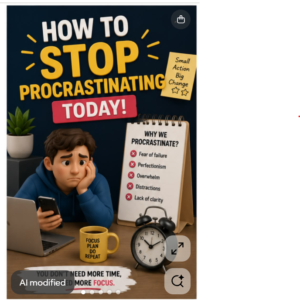
How to Stop Procrastinating Today: 5 Practical Steps to Reclaim Your Focus
We’ve all been there. You sit down at your desk with a long to-do list, determined to be productive. But instead of tackling your most important task, you find yourself checking social media, organizing your inbox, or staring blankly at your phone.
Before you know it, hours have passed, and that looming deadline is even closer.
If you constantly find yourself saying, “I’ll do it tomorrow,” you don’t need more time—you need more focus. Procrastination isn’t a time management problem; it’s an emotional and psychological hurdle. The good news? You can break the cycle.
Here is a breakdown of why we delay our tasks and a simple, actionable framework to stop procrastinating today.
Why Do We Procrastinate? Understanding the Root Causes
To defeat procrastination, you first need to understand what is driving it. It rarely stems from pure laziness. Instead, it is usually triggered by one of these five core psychological barriers:
Fear of Failure: When a task feels tied to your self-worth, it feels safer to delay it than to attempt it and risk failing.
Perfectionism: The unrealistic expectation that your work must be flawless from the very first draft can paralyze you before you even start.
Overwhelm: When a project feels massive, your brain views it as a threat and looks for an immediate escape route.
Distractions: Notifications, open tabs, and nearby smartphones offer instant gratification, pulling your mind away from deep work.
Lack of Clarity: If you don’t know exactly what the very next step is, your brain will naturally default to doing nothing.
The “Focus, Plan, Do, Repeat” Framework
Overcoming chronic delay doesn’t require a massive lifestyle overhaul. As the saying goes: Small action, big change. By shifting your daily habits, you can train your brain to build momentum.
Here is a simple four-step loop to help you beat productivity paralysis:
1. Focus (Eliminate the Friction)
Your environment dictates your behavior. Before you start working, ruthlessly eliminate distractions. Put your phone in another room, use a website blocker to restrict social media, and clear your physical desk. Energy flows where attention goes.
2. Plan (Break It Down)
The biggest mistake is writing vague goals like “Work on project.” Instead, break your massive goal into micro-steps. If you need to write a report, your first step shouldn’t be “write the report”—it should be “open a blank document and write three bullet points.” Make the entry barrier so incredibly low that your brain can’t argue against it.
3. Do (The 5-Minute Rule)
The hardest part of any task is simply starting. Give yourself permission to work on a task for just five minutes. If you want to stop after five minutes, you can. More often than not, once you cross the initial threshold of friction, momentum takes over and you will want to keep going.
4. Repeat (Build the Habit)
Consistency beats intensity. Reclaim your focus in short, focused bursts throughout the day (such as using the Pomodoro Technique—25 minutes of work followed by a 5-minute break). Repeat this cycle until it becomes your default workflow.
Key Takeaway: You will never “feel” like doing the hard things. Don’t wait for motivation to strike before you take action. Action creates motivation.