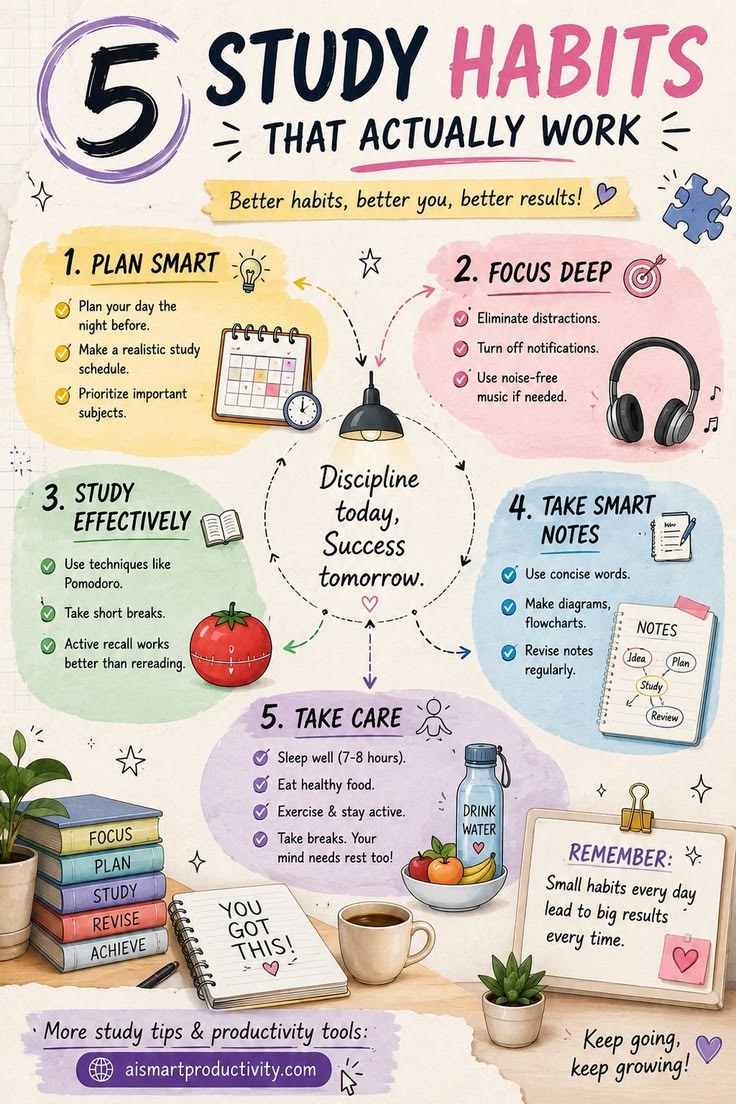
Studying harder isn’t always the key to better grades—studying smarter is. Many students fall into the trap of spending hours re-reading textbooks or highlighting entire pages without retaining much information. By replacing ineffective routines with proven strategies, you can boost your retention, focus, and productivity while reducing burnout.
Here are five simple, science-backed study habits that actually work.
1. Plan Smart
Success starts before you open your books. Taking a few minutes to organize your schedule eliminates decision fatigue and ensures you focus on what truly matters.
Plan your day the night before: Mapping out your tasks ahead of time allows you to jump straight into learning without wasting morning energy figuring out where to start.
Make a realistic study schedule: Avoid overcommitting. Set achievable time slots for each task so you stay consistent without feeling overwhelmed.
Prioritize high-impact subjects: Focus on challenging or urgent topics first when your mind is freshest.
2. Focus Deep
Distractions are the enemy of effective learning. Multitasking slows down comprehension and drains mental energy faster than single-task concentration.
Eliminate distractions: Set up a quiet, clean workspace dedicated solely to study sessions.
Turn off notifications: Put your phone on “Do Not Disturb” mode or place it in another room to break the temptation to check updates.
Use focus-enhancing music: If silence feels uncomfortable, listen to noise-free ambient sounds, instrumental tracks, or lo-fi music to maintain deep concentration.
3. Study Effectively
How you process information determines how well you remember it. Rereading material creates an illusion of mastery, whereas active strategies build real memory pathways.
Use active recall: Testing yourself or summarizing concepts from memory is far more effective than passively reading notes over and over.
Leverage the Pomodoro Technique: Work in focused blocks (e.g., 25 minutes) followed by short rest periods to keep your brain fresh.
Take short breaks: Regular intervals prevent mental exhaustion and help consolidate information in long-term memory.
4. Take Smart Notes
Good note-taking isn’t about writing down every single word your teacher or textbook says; it’s about synthesizing concepts into memorable visuals and summaries.
Use concise language: Summarize information using key terms, short phrases, and your own words rather than long, verbatim sentences.
Incorporate visuals: Create diagrams, mind maps, and flowcharts to map out relationships between complex concepts visually.
Revise notes regularly: Review your notes within 24 hours of writing them, and schedule periodic reviews to reinforce retention over time.
5. Take Care of Yourself
Your brain is a physical organ that requires care to function at its peak. Physical well-being directly impacts focus, memory retention, and stress management.
Sleep well (7–8 hours): Sleep is essential for memory consolidation and cognitive performance. Cutting sleep to study usually backfires.
Eat healthy food & stay hydrated: Fuel your body with nutritious meals and plenty of water to maintain steady energy levels throughout the day.
Exercise & stay active: Regular physical activity increases blood flow to the brain, enhancing mood, alertness, and mental clarity.
Give your mind rest: Schedule true downtime where you step away from work completely to recharge your mental energy.
Small Habits, Big Results
Achieving your academic goals isn’t about drastic overnight changes; it’s about discipline today and consistency over time. As the saying goes, “Discipline today, success tomorrow.” By building these small habits into your daily routine, you will set yourself up for long-term growth and steady achievement.
Which of these study habits will you try implementing into your schedule today?