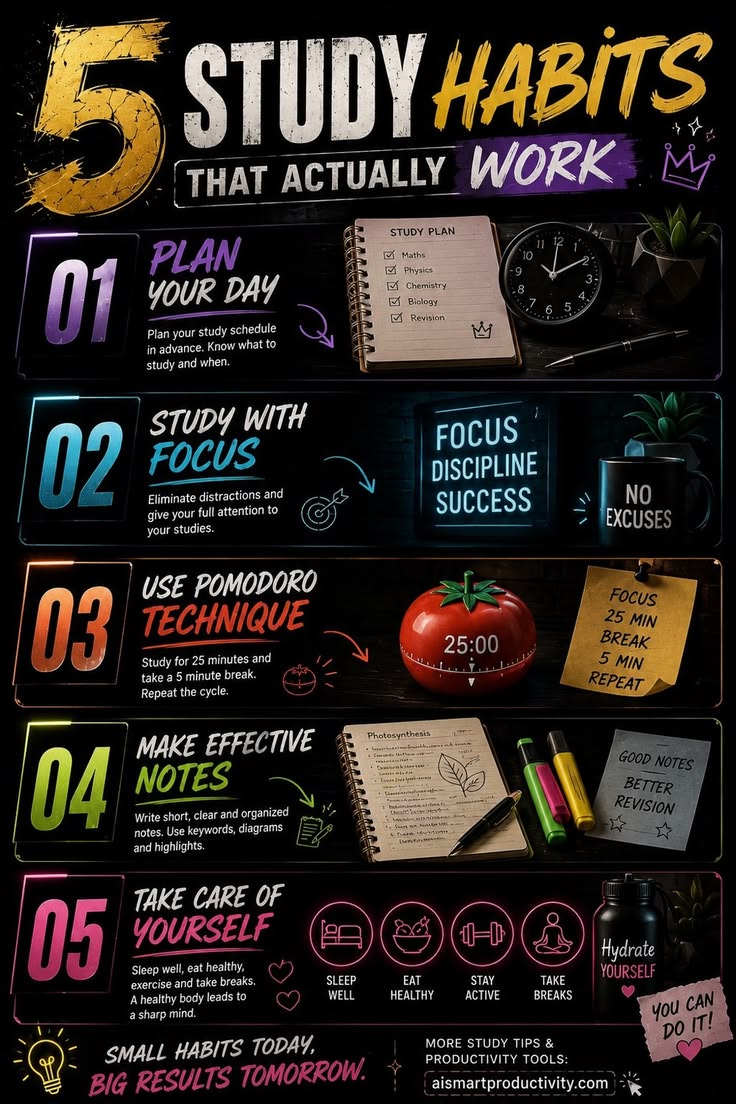
Studying longer doesn’t automatically equal studying better. Pulling all-nighters or sitting in front of a textbook for hours without focus often leads to burnout rather than high marks. To achieve consistent success, the goal is to shift from passive effort to high-impact routines.
Here are five practical, proven study habits that can transform your daily productivity and help you retain what you learn.
01. Plan Your Day
Unstructured study sessions waste valuable time and energy. When you sit down without a roadmap, you spend more energy deciding what to study than actually learning.
Plan in advance: Map out your study schedule before starting your day so you know exactly what to tackle and when.
Organize by subject: Breakdown your sessions into specific topics (e.g., Maths, Physics, Chemistry, Biology, and Revision) to keep your focus sharp and balanced.
Remove decision fatigue: Clear goals allow you to dive straight into productive work without hesitation.
02. Study with Focus
Multitasking is one of the biggest obstacles to deep learning. Frequent interruptions reset your focus and make understanding complex concepts much harder.
Eliminate distractions: Put away your phone, close unnecessary browser tabs, and create a dedicated workspace free of noise.
Build mental discipline: Give your full, undivided attention to one subject at a time to maximize information retention.
Adopt a “No Excuses” mindset: Dedicate fixed windows of time purely to continuous, deep study work.
03. Use the Pomodoro Technique
Maintaining intense concentration for hours on end is mentally exhausting. Structuring your learning into short, focused sprints keeps your brain engaged and prevents fatigue.
Follow the 25/5 rule: Study with complete focus for 25 minutes, then take a full 5-minute break.
Repeat the cycle: Complete 3–4 cycles before taking a longer rest period (15–30 minutes) to refresh your mental energy.
Prevent burnout: Regular intervals keep your cognitive performance high throughout long study sessions.
04. Make Effective Notes
Simply reading text over and over creates a false sense of mastery. Transforming complex concepts into structured, visual summaries forces your brain to actively process information.
Keep it concise: Write short, clear, and well-organized notes using simple keywords rather than full textbook sentences.
Incorporate visuals: Draw diagrams, mind maps, and flowcharts to make key concepts easier to visualize and remember.
Highlight key points: Use color-coding to emphasize core concepts, formulas, and definitions for quick revision before exams.
05. Take Care of Yourself
Your physical health dictates your cognitive performance. Neglecting sleep, nutrition, or physical activity directly impairs memory, focus, and mood.
Sleep well: Prioritize consistent rest to allow your brain to consolidate memories and recover.
Eat healthy & hydrate: Nourish your body with nutritious food and stay hydrated throughout the day to keep your energy levels steady.
Stay active: Incorporate regular exercise and movement into your routine to boost blood flow and mental clarity.
Take meaningful breaks: Step away from your desk completely during downtime so your mind gets a true rest.
Small Habits Today, Big Results Tomorrow
High achievement isn’t about single, massive efforts—it’s the result of small, consistent habits repeated daily. By structuring your day, protecting your focus, and taking care of your well-being, you pave the way for sustainable success.