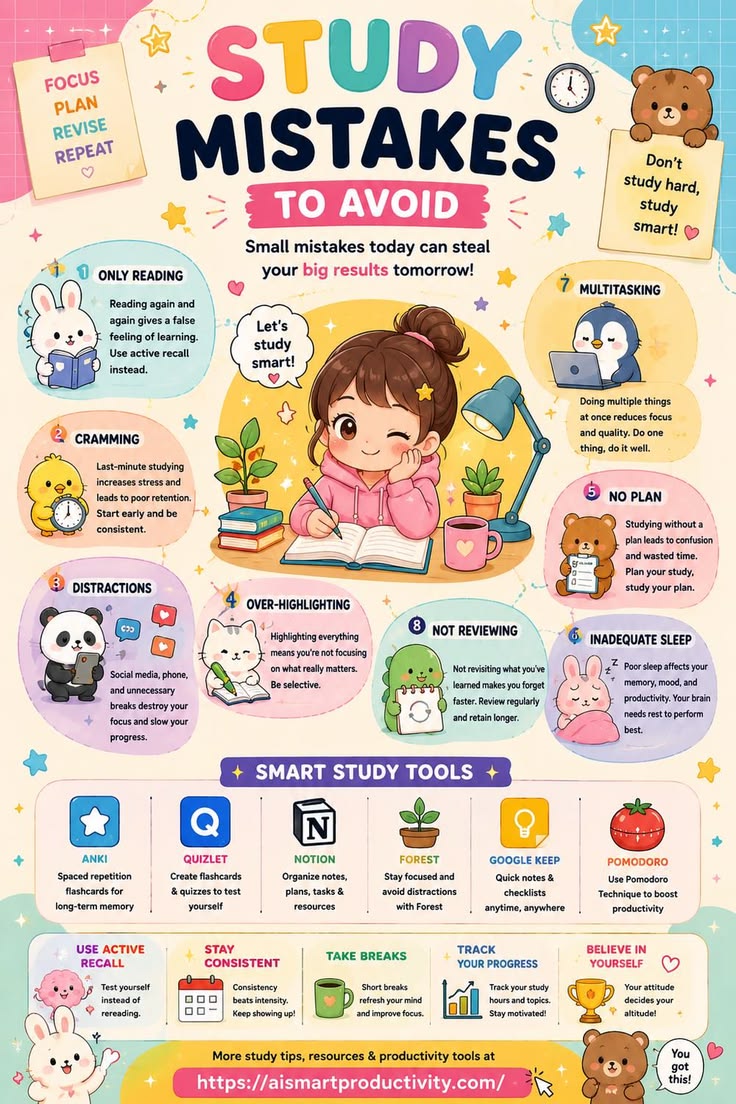
Small mistakes today can steal your big results tomorrow. Most students don’t fail because they lack effort — they fail because they’re using study habits that feel productive but don’t actually build lasting knowledge. Below is a step-by-step breakdown of the eight most common study mistakes, why they hurt you, and exactly what to do instead.
Step 1: Stop Only Re-Reading — Use Active Recall
Reading your notes or textbook over and over creates a false sense of learning. Your brain recognizes the material and mistakes that familiarity for actual mastery.
Do this instead: Close the book and try to recall the information from memory. Quiz yourself, explain the concept out loud, or write down what you remember before checking your notes again.
Step 2: Stop Cramming — Start Early and Stay Consistent
Last-minute studying spikes stress and leads to poor retention. Information crammed in the night before rarely makes it into long-term memory.
Do this instead: Break your material into small chunks and study a little each day. Consistency beats intensity every time.
Step 3: Eliminate Distractions
Social media, phone notifications, and unnecessary breaks quietly destroy your focus and slow your progress, even if each interruption feels short.
Do this instead: Put your phone in another room or use a focus app, close unrelated tabs, and study in a dedicated distraction-free space.
Step 4: Avoid Over-Highlighting
Highlighting entire pages feels productive but actually means you’re not identifying what really matters. When everything is marked as important, nothing is.
Do this instead: Be selective. Highlight only key terms, definitions, or ideas you’ll need to actively recall later.
Step 5: Always Study With a Plan
Studying without a plan leads to confusion and wasted time. Sitting down without knowing what you’ll cover is a recipe for aimless, low-value study sessions.
Do this instead: Plan your study, then study your plan — outline topics, set time blocks, and know your goal for each session before you start.
Step 6: Prioritize Sleep
Poor sleep affects your memory, mood, and productivity. Your brain needs rest to consolidate what you’ve learned and perform at its best.
Do this instead: Protect a consistent sleep schedule, especially before exams — an extra hour of sleep often beats an extra hour of studying.
Step 7: Stop Multitasking
Doing multiple things at once — watching videos while reviewing notes, texting while reading — reduces both focus and quality.
Do this instead: Do one thing, and do it well. Single-tasking gets you done faster and helps the material actually stick.
Step 8: Review Regularly, Don’t Skip It
Not revisiting material you’ve already learned makes you forget it faster. Studying something once and moving on guarantees you’ll have to relearn it later.
Do this instead: Build in regular review sessions (spaced repetition works especially well) to reinforce and retain information long-term.
Smart Study Tools to Support These Habits
Pairing good habits with the right tools makes them easier to stick to:
Anki – Spaced repetition flashcards for long-term memory
Quizlet – Create flashcards and quizzes to test yourself
Notion – Organize notes, plans, tasks, and resources
Forest – Stay focused and avoid distractions
Google Keep – Quick notes and checklists anytime, anywhere
Pomodoro Technique – Use timed work/break intervals to boost productivity
Five Extra Principles to Study By
Use active recall – Test yourself instead of just re-reading.
Stay consistent – Consistency beats intensity; keep showing up.
Take breaks – Short breaks refresh your mind and improve focus.
Track your progress – Monitor your study hours and topics to stay motivated.
Believe in yourself – Your attitude decides your altitude.