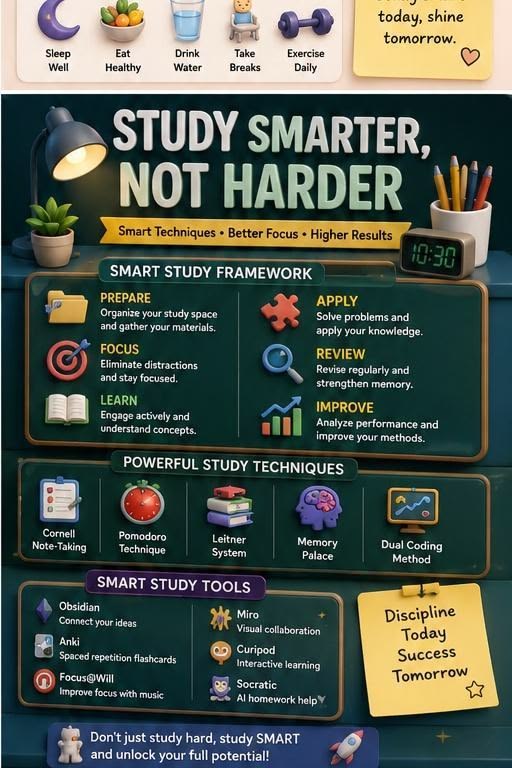
Studying long hours doesn’t guarantee top marks. To truly retain information and excel in exams, you need a strategy that prioritizes focus and efficiency over brute force. Here is a step-by-step guide, study checklist, and framework based on modern learning science to help you maximize your results.
The Smart Study Framework
A structured routine keeps your mind organized and reduces exam stress. Follow this six-phase framework during every study session:
Prepare: Organize your workspace, silence unnecessary notifications, and gather all books, notes, and tools before starting.
Focus: Eliminate digital distractions and work in structured, intense focus blocks.
Learn: Engage actively with the material rather than passively re-reading text.
Apply: Test your understanding immediately by solving practice problems, flashcards, or past papers.
Review: Revisit key concepts at systematic intervals to consolidate long-term memory.
Improve: Track your progress, identify weak areas, and adjust your preparation strategy accordingly.
5 Powerful Study Techniques
Integrating proven cognitive strategies into your routine speeds up learning:
Pomodoro Technique: Work for 25 minutes with single-task focus, then take a 5-minute break. Repeat four times before taking a longer 15–30 minute break.
Cornell Note-Taking: Split your page into cues/questions on the left, main notes on the right, and a brief summary at the bottom to structure your insights clearly.
Leitner System: Use physical or digital flashcards categorized into boxes based on how well you know each concept, reviewing difficult cards more frequently.
Memory Palace: Associate key terms or lists with physical locations in a familiar room or building to recall complex sequences effortlessly.
Dual Coding Method: Combine visual diagrams, mind maps, or flowcharts with textual notes to engage multiple sensory pathways in the brain.
Essential Smart Study Tools
Enhance your productivity with modern study software:
Obsidian: Ideal for non-linear note-taking and linking interconnected ideas.
Anki: Harnesses spaced repetition algorithms for optimal flashcard retention.
Focus@Will: Uses optimized background music engineered to sustain mental focus.
Miro: Excellent for visual brainstorming, diagrams, and collaborative whiteboarding.
Curipod & Socratic: Helpful for interactive learning and AI-assisted homework explanations.
Daily Student Study Checklist
Use this checklist daily to maintain focus, discipline, and well-being:
Daily Habits & Wellness
[ ] Sleep Well: Aim for 7–8 hours of quality rest.
[ ] Eat Healthy: Fuel your brain with balanced meals.
[ ] Drink Water: Stay hydrated throughout the day.
[ ] Take Breaks: Rest your eyes and clear your mind between sessions.
[ ] Exercise Daily: Light physical activity boosts focus and reduces mental fatigue.
Study Session Routine
[ ] Workspace cleared of physical and digital clutter.
[ ] Study targets set for the session (specific chapters, topics, or problem sets).
[ ] Active study technique selected (e.g., Active Recall, Pomodoro, Cornell Notes).
[ ] Phone on ‘Do Not Disturb’ or placed in another room.
[ ] Completed self-assessment / active recall questions before closing the book..